
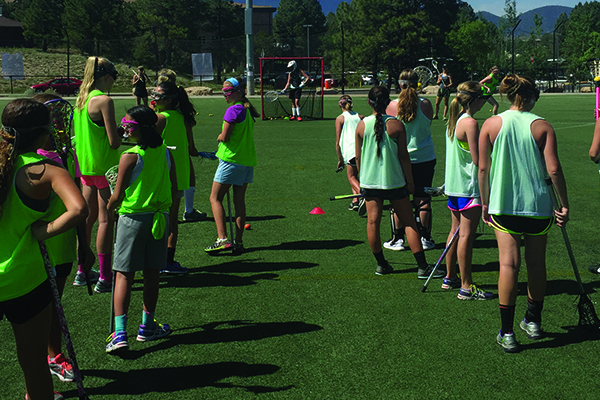
Regardless of the level of play, an essential part of any lacrosse player’s game is how they’re able to control their stick during both games and practices. Since stickhandling is such a critical part of any lax player’s game, mastering that particular technique in various situations will lead to that confidence rubbing off in other places on the field.
There’s also no substitute for a lacrosse team that can effectively catch and throw passes to one another under pressure. There are a lot of defensive strategies that help lead to success, but if a squad has this one fundamental part of the game down, it’ll be hard for their opponents to stop them.
For youth lacrosse players who are more beginners than anything else, it’s important to keep things simple by emphasizing the basics. Once that becomes a natural reflex, it’ll be time to introduce more complicated aspects. Lacrosse is a game of constant movement and pressure, so it’s easy to panic and make mistakes – whether we’re talking from a physical or mental standpoint – especially when you don’t feel as prepared as possible upon stepping onto the field.
If you’re planning on spending part of your summer going to lacrosse camp, then you should check out the options we have available at GameBreaker because we hit on a little bit of everything during your time with us. Outside of working on stick skills, our coaches and camp directors put together an experience that also allows youth lax players to improve their shooting, ground balls, defense (both team and individual), fast breaks, dodging, triangle offense, clears, face-off and wing play, and man up, man down.
There are tons of lacrosse stick drills out there that you can do to improve this area of your game. Here are five that we think are super helpful — starting with two you can do entirely on your own, followed by three team drills to run at practice.
Solo Stick Skill Drills
Top Hand Only Triple Threat
Sometimes, even the simplest of drills can help you in a big way. A huge part of being a great lacrosse player is being in control — not just of your body as you’re moving down the field, but also while you’re moving with the ball. This drill will allow you more control in a bunch of different situations, which ultimately raises your overall skill as a lax player.
Not allowing too much overall movement while you’re cradling the ball will keep the opposing team guessing because they won’t be able to tell whether you’re about to dodge them, pass it to a teammate, or shoot at the goal.
Around the World Flip to Catch
Here’s something that will be a good challenge as you look to improve your stick skills because you’re doing this entire thing by yourself. As you toss the ball to yourself from behind your own back, the first objective will be to simply get the drill down because it’s difficult to bring the stick around your face and toss the ball without actually seeing yourself doing it.
Once the reps are in and you’ve got the move itself down, that’s when you can continue making things more difficult to challenge yourself to improve. For example, you can limit how high the ball gets thrown so the trajectory around you continually gets tighter.
Team Stick Drills
Stickwork Inside the Center Circle
This is a great drill to use – yup, you guessed it – in the center circle! It’s also great as a warm-up drill that will not only improve stickwork, but also quick decision-making skills. The activity itself will force players to keep their heads up and eyes open so they can find an open teammate to pass a ball to while also making sure they’re ready to catch a pass from a different teammate.
The key here is that you can’t return the ball to the teammate who just passed it to you, so you’re forced to look around and anticipate someone else to be open.
The Waterfall Drill
This is a great drill because it helps players work on making both short and long passes while on the run. Some extra benefits are that goalies can also be included, and there’s a bit of conditioning work that’s a byproduct of it all.
Players will form two lines, with one having the balls. The drill starts with one player from each line running up the middle of the field while passing the ball back and forth. After making these short passes all the way down to the opposite end line, they then practice long passes across the field by going wider on the run back.
The Give-and-Go Drill
Learning how to pass on the run and under pressure are two skills every successful lacrosse player possesses. The give-and-go drill is a great way to hone that particular skill as much as possible.
Start this drill by having two lines of players lining up at the top of the 12-meter arc. Once again, one line of players has the balls, but now have a coach stand in front of the players who have the ball. That player will then feed the ball to the other line before sprinting toward the goal. After the players in the second line catch the ball, they must switch hands before throwing a lead pass toward their teammate breaking toward the goal.
Upon a catch and shot taking place, the players should return to the back of the line and wait for their next turn.
Ready to take your lax game to the next level this summer? Find a GameBreaker Lacrosse Camp near you and register today!
Recent Blog Posts
How College Lacrosse Recruiting Has Changed in the Last Five Years
College lacrosse recruiting looks a lot different today than it did just five years ago. Timelines have shifted, evaluation methods have evolved, and the strategies that worked for previous generations of players no longer produce [Read More>]
How Lacrosse Players Can Train Smarter Without Overtraining
Lacrosse players face constant pressure to “do more,” whether it includes training harder, attending more camps, and participating in year-round programming. While dedication can lead to drastic improvement, there's a real difference between training smart [Read More>]
How Lacrosse Camps Help Players Transition Between Youth and High School Play
The jump from youth lacrosse to high school competition is one of the toughest transitions your child will face as an athlete. The game moves faster, opponents are stronger, and coaches expect higher-level skills/awareness. Lacrosse [Read More>]